Description of the DRI
Dronetag DRI is a Remote ID broadcast module designed to meet regulatory requirements in the US and EU.
It enables compliance without developing a custom RF solution or firmware.
Features
Sophisticated UART Bypass / Forwarding
Dronetag DRI will not take away any of your existing ports. Thanks to our UART forwarding feature, you can integrate it between the flight controller and your serial peripheral. Just enable port forwarding in the Dronetag App and connect the Dronetag DRI between your flight controller and the serial peripheral.
Standardized SN
Our DRI module already has an ANSI/CTA-2063-A serial number baked in. Refer to this SN during the compliance process without worrying about managing your own sequence.
ASD-STAN EN 4709-002 & ASTM F3411-22 compliant
Suitable for all regions adopting either of these standards. Broadcasts over Bluetooth 4 & 5 with a range of up to 3 km (1.86 miles). The distance may vary depending on the integration level and the position of the DRI on the drone.
Variants
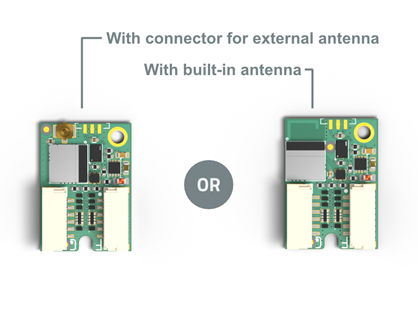
We produce two variants of the Dronetag DRI: one with a U.FL connector for an external antenna, and one with an internal antenna already on board.
-
The internal‑antenna variant is best understood as a testing and development module. It is a convenient starting point for testing integration and experimenting with mounting options, especially on plastic airframes. However, its integrated antenna does not meet the performance requirements for regulatory certification. For this reason, it should not be used in final certified products.
-
The U.FL connector variant provides the flexibility to attach an external antenna of your choice or from our list of preapproved antennas. This is the recommended option for product integration, as it allows you to achieve the required RF performance and compliance. It is particularly useful when integrating the DRI into carbon‑fiber or otherwise RF‑challenging aircraft, where antenna placement is critical.
This variant is primarily intended for manufacturers who need to meet regulatory requirements. Because the module is FCC‑certified with preapproved antennas, it can be easily incorporated into a product under the Contains FCC ID framework, significantly simplifying the certification process.
Firmware Variants
Independently of which hardware variant you have, every DRI can also run one of two firmware variants, switchable at any time from the Dronetag Toolbox app:
- Standard DRI firmware - the DRI is fed position, pressure, and identification data by a MAVLink-speaking flight controller. This is the variant covered throughout this documentation.
- DRI GNSS firmware - for flight controllers that don't speak MAVLink (e.g., Betaflight-based builds). The DRI instead reads position from an external u-blox GNSS receiver connected to its Forward port, and can relay that data back out to a flight controller on its Controller port.
See DRI GNSS for details on when to use it and how to switch.
Specification
Dronetag DRI transmits position and identification data adhering to Direct (Broadcast) Remote ID regulations. Its transmission follows the standards outlined in prEN 4709-002 for the EU and ASTM F3411 for the US. Dronetag DRI has been accepted by the FAA as one of the initial Remote ID modules. You can verify the Declaration of Compliance here.
| Parameter | Value |
|---|---|
| Short-range radio | Bluetooth 2.4 GHz |
| Bluetooth output power | 8 dBm |
| Remote ID technology | Bluetooth 4.0 Legacy + 5.0 Long Range |
| Sensors | None, data read from flight controller |
| Indicators | RGB LED to show the state |
| Antenna | Variant with internal or external antenna |
| Antenna Connectors | Optionally 1× U.FL (IPEX compatible) |
| Communication Connectors | 2× JST GH 6-pin (1.25 mm pitch) |
| Communication Protocol | UART (3.3 – 5V tolerant) |
| Supported Message Protocol | MAVLink 2 |
| Supported baud rates | Standard ones – configurable in Dronetag App |
| Input voltage | 3.3 – 17V |
| Input voltage regulator | Low-noise buck converter |
| Average current consumption | 3 mA |
| Maximum current consumption | 10 mA |
| Mounting mechanism | M2 holes or double-sided tape |
| Operating temperature | -40°C to +85°C (-40°F to 185°F) |
| Dimensions | 22.5 × 16 × 5 mm (0.89 × 0.62 × 0.19 in) |
| Weight | with JST connectors 1.5 g (0.056 oz) |
| Weight | without JST connectors 0.5 g (0.017 oz) |
| Remote ID Standards | ASD-STAN EN 4709-002 & ASTM F3411-22 |
| Certifications | Uses FCC/CE approved radio module |
3D Assets
Visit the downloads section to get the 3D model of the device.
What's in the Box
After receiving the DRI package, the following should be present:
Dronetag DRI (the variant you have chosen) | |
Pixhawk 6-PIN GH to 6-PIN GH Cable 10 cm | 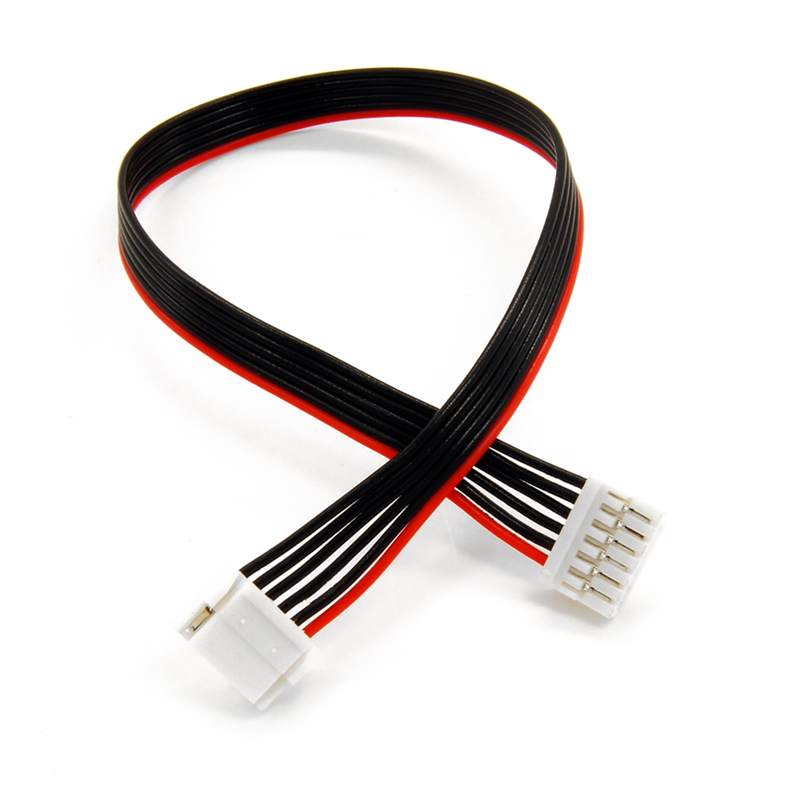 |
If you purchased the DRI with an external U.FL antenna port, the package contains:
Bluetooth Wire Antenna | 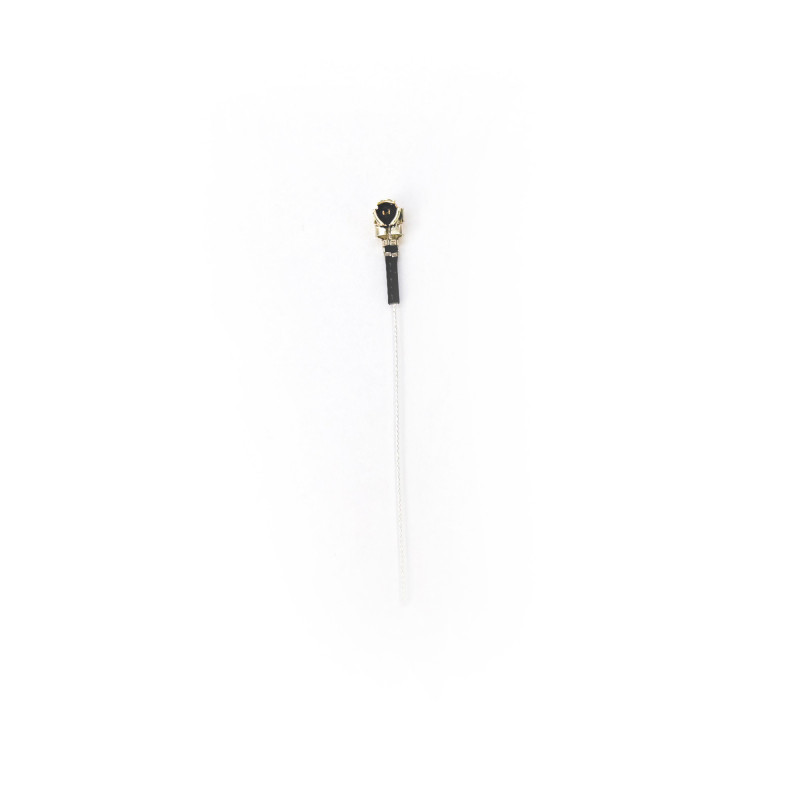 |