Specification
Dronetag RIDER is a mobile Remote ID receiver designed to detect and track drones compliant with Remote ID standards in the EU, US, and Japan. It supports both Bluetooth and Wi-Fi-based detection technologies, making it capable of identifying drones regardless of whether they have built-in Remote ID or are using a module. This functionality ensures seamless integration with diverse drone ecosystems.
| Parameter | Value |
|---|---|
| Weight | 64 grams with antenna, 55.5 grams without antenna |
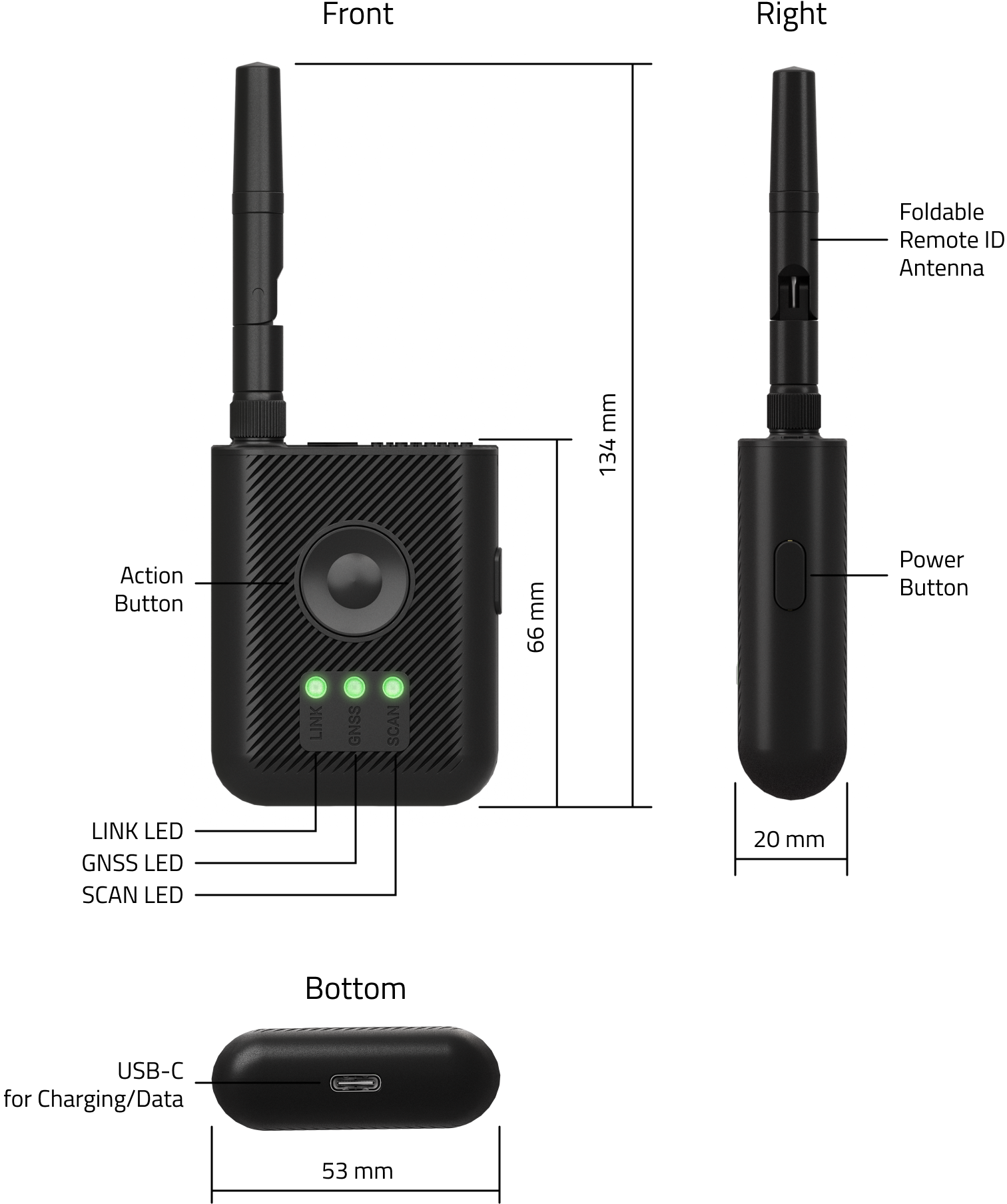
| Dimensions | 138×55×18 mm with extended antenna, 75×55×18 mm without extended antenna |
| Power Supply | 5 V via USB-C |
| Battery | Li-Po 1000 mAh |
| Battery Life | up to 10 hours |
| Charging Time | 2.5 hours from 0% to 100% |
| Operating Temperature | -20°C to +60°C (-4°F to 140°F) |
| Range | Up to 5 km (10 km extendable with optional high-performance antenna) |
| IP Rating | IP54 |
| Supported LTE Bands | 1, 2, 3, 4, 5, 8, 12, 18, 19, 20, 26, 28 |
| Supported GNSS Frequencies | GPS L1, GLONASS L1, Galileo E1, BeiDou B1C, SBAS, QZSS |
| Remote ID Technologies | Bluetooth 4, Bluetooth 5 Long Range, 2.4 GHz Wi-Fi Beacon, 2.4 GHz Wi-Fi NAN |
| Antenna connector | SMA female |
For further details or inquiries, contact Dronetag Support.
📡 Why Dronetag RIDER Has a GNSS Module
The GNSS module (Global Navigation Satellite System) in your Dronetag RIDER provides precise location and time data for the device itself.
This is essential for several key functions:
- To display the exact position of your RIDER on the map in the Dronetag app.
- To correctly associate the RIDER’s position with nearby detected drones.
- To ensure accurate time synchronization for detection events.
- To improve situational awareness during drone operations.
Thanks to its built-in GNSS, your RIDER can show where it is physically located on the map — helping you understand which detections belong to your device, even if you have multiple RIDERs deployed.
Unlike SCOUT, which is usually installed at a fixed location, the RIDER is portable and may be used in different areas.
That’s why having its own GNSS receiver is crucial — it lets the system know where the RIDER is, not just where detected drones are.